
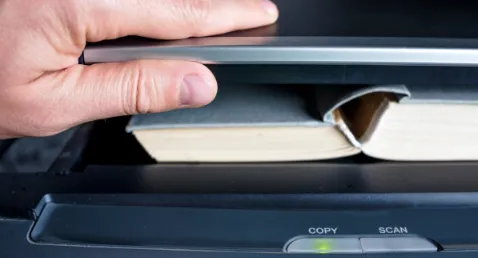
Grandchildren who want to reprint their grandfather’s sefer, institutions that want to renew a sefer that is out of print, and authors who have only an old printing of their work all turn to us. The first question is almost always: how much will it cost? The honest answer is that every sefer is different, and the price depends on the sefer itself and on what you want to receive at the end. To help you know what to ask and what to prepare, here are the things that determine the price.
First: what do you want at the end?
There are two main ways to reprint an old sefer. The first is a photo edition: the old pages are cleaned and restored and printed as they are, without retyping. The second is a new edition: the sefer is turned into text, proofread, edited as needed, and typeset again in clear letters. Each way is a different scope of work, and so a different price.
Another question worth thinking about in advance: do you need only a file, such as a digital sefer, or a printed and bound sefer, and how many copies?
What affects the price
The size of the sefer. The price is set by the amount of text, not only by the number of pages. A dense page in small letters holds much more text than a page in large letters.
The condition of the original and the fonts. A new, clear print is simpler than an old print with faded or damaged letters. Rashi script, two columns or commentaries around the text also affect the work.
Print or handwriting. A manuscript is not scanned like a printed page. It is deciphered and typed by experienced readers, and old scripts, such as half-cursive or Italian script, are work for experts.
Nikud. Vowelized text requires more work, and it makes a difference whether the original nikud is kept, full nikud is added, or only the pesukim are vowelized. For a sefer with nikud, the quote states in advance how the nikud will be handled, so that everything is clear to both sides.
Additions to the scanning. For example, opening abbreviations and roshei teivos, completing cut-off words, or keeping the page and line breaks of the original.
The schedule. Urgent work also affects the price.
The institute’s smart scanning is done with software and equipment we have developed over many years, and it is delivered at 99.9% accuracy within 48 hours, for any sefer of any size, including old and faded prints.
What is needed after scanning
Not every sefer needs every stage. You can order the whole way, from the old page to the printed sefer, or only part of it, and each stage you choose is included in the quote.
Proofreading. Careful reading against the original: spelling, punctuation, and nikud where needed. You can choose several rounds of proofreading, and there is also proofreading after typesetting.
Editing and source references. From light editing of punctuation and language to full Torah editing, with sources, headings and notes. The editing is done by talmidei chachamim, and each level is chosen separately.
Typesetting. A sefer with one text is simpler than a sefer with footnotes, two texts or a Gemara-style page. The size of the sefer, and the choice between following an existing sample or a new design, also matter.
Cover and title pages. Design of the cover and title page, and if you wish, a dedication or memorial page.
Additional services. Indexes, ISBN, a digital edition and distribution to seforim stores.
Printing: how many copies, and how fine
The institute also provides the printing itself, working with the large printing houses. You receive from us a printed and bound sefer, ready, without dealing with printers. The cost of printing depends on the number of copies and pages, the size of the sefer and the type of paper, a hard or soft cover, and finishing such as gold stamping, a ribbon marker or colored edges. Small runs are possible too. And if you prefer your own printer, you receive from us print-ready files.
What you receive at each stage
Advice and a price quote. An expert editor looks at the material and advises you, at no cost and with no obligation, and then sends an orderly price quote.
After scanning. A text file you can edit and search, such as a Word file or a searchable PDF, according to what the sefer needs.
During proofreading and editing. Proofs for your review and comments.
Before print. The sefer goes to print only after your final approval, and we accompany it until it is bound.
At the end. Shipping anywhere in Israel and abroad, and if needed, distribution to seforim stores.
Throughout the way, the sefer passes between two departments: the scanning and digital department headed by Rabbi Yochanan Segal, and the publishing department headed by the chief editor, Rabbi Shlomo Kleinman. With them is a team of about fifty talmidei chachamim and professionals, with experience since 1999 and 938 seforim published.
How to get an exact quote
The simple way is to send us a few pages of the sefer, photographed or scanned, and write in a few words: how many pages the sefer has, whether it is printed or handwritten, whether it has nikud, what you would like to receive at the end, how many copies, and by when it needs to be ready. The more details you give, the more exact the quote we can offer. And if you want to see the result first, you can receive a free sample of 2 to 3 pages of your sefer before ordering.
- WhatsApp: +972 52-472-6157
- Phone in Israel: +972 50-413-1411
- Phone in the US: 718-337-8895, 718-841-8535
- Email: office@tozhaot.co.il
- Or through the form on our site
Customers abroad send the sefer or the material in whatever way suits them: by mail, as a file or any other way, and receive the price quote in dollars. We speak Hebrew, Yiddish and English. And no job is too small: even if you need only a few pages, you will receive an answer and a quote.
Send us one page of your sefer, or call us, and an expert editor will advise you, at no cost and with no obligation, on what is right for your sefer.
